There is a conversation we have had in a lot of small commercial buildings in BC, and it goes roughly the same way every time.
Someone asks whether the building has fire detection. Someone else says yes — there is a smoke detector in the back hallway, it is wired into the alarm panel, and the monitoring company gets the signal. Everyone moves on to the next item.
Sometimes that is a complete and correct answer. Sometimes it is not, and nobody in the room can tell which, because the question that decides it was never asked.
Is a smoke detector on a burglar alarm a fire alarm system?
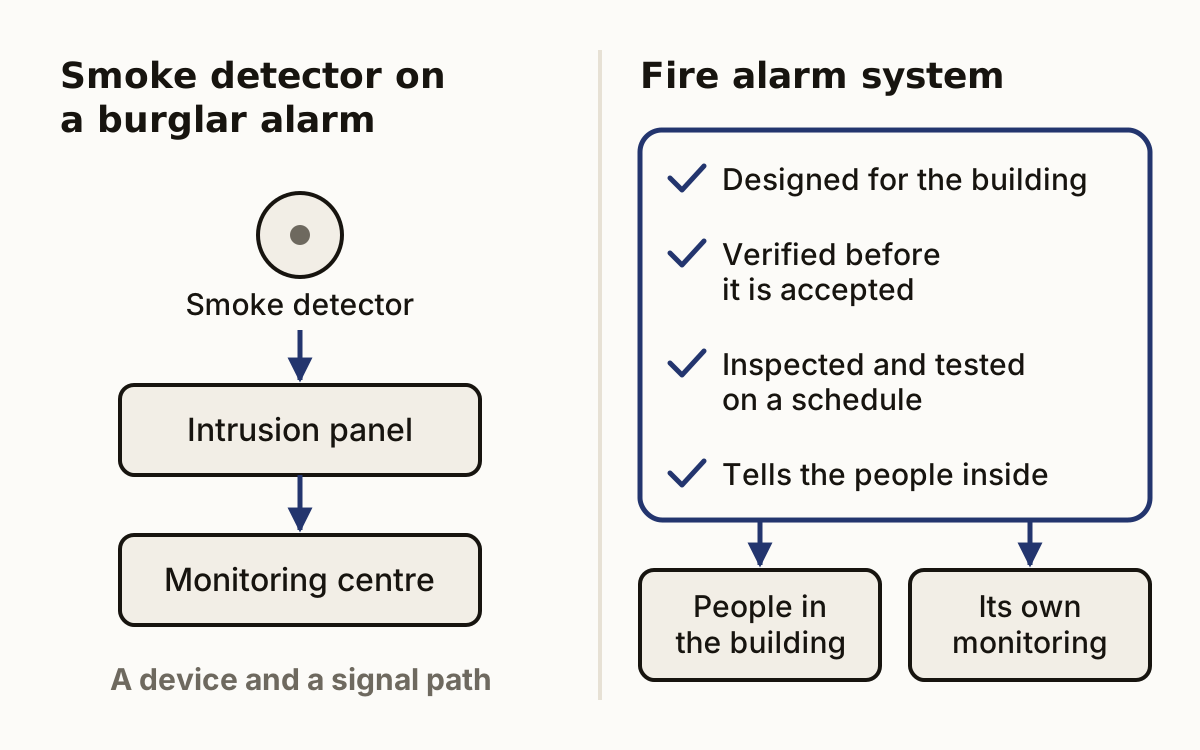
No. It is a device reporting through the security panel to a monitoring centre; a fire alarm system is designed, verified, inspected and tested as a system.
A smoke detector connected to an intrusion panel is a real device doing a real job. It is not a decoration and it is not a scam. When it senses products of combustion, it puts a signal onto the panel, and if the panel is monitored, that signal leaves the building.
That is worth something. A building with a monitored smoke signal is better positioned than a building with nothing at all, particularly outside occupied hours, when a fire that starts at two in the morning has nobody standing next to it. It is not the thing to remove.
But describe it precisely, because the precision is the whole point: what you have is a detector on a security system, reporting to a monitoring centre. It is a device and a signal path. Its scope is whatever the panel's zones happen to cover, which in most buildings we walk means one detector or a small handful, placed where the intrusion install was already running wire.
What qualifies as a fire alarm system?
A system designed for the building, installed to a defined standard, verified before it is accepted, monitored under its own arrangement, and inspected and tested on a schedule.
A fire alarm system is not a bigger version of that. It is a different category of thing.
Where a smoke detector on your intrusion panel is a component, a fire alarm system is a system in the regulatory sense: designed for the building, installed to a defined standard, commissioned and verified before it is accepted, monitored under its own arrangements, and then inspected and tested on a schedule for the rest of its life. Each of those stages has requirements attached, and each produces paperwork somebody can ask you for.
The practical differences an owner can see without opening a code book:
Coverage is designed, not incidental. A fire alarm system's device layout is worked out for the building — its rooms, its ceilings, its occupancies, its zones. Detectors on an intrusion panel sit where somebody put them.
Occupant notification is part of it. A fire alarm system's job includes telling the people inside the building. A monitored smoke signal on an intrusion panel tells a monitoring centre. Those are not the same event, and the difference matters most in a building where people are asleep, distracted, or wearing hearing protection.
It is verified before anyone relies on it. New fire alarm work goes through a formal verification process, performed and documented by someone qualified to perform it, before the system is accepted. It is not "the technician tested it and it seemed fine."
It carries a standing inspection and testing regime. Periodic inspection and testing of a fire alarm system is a recurring obligation with records attached, not an optional service contract.
It interacts with the rest of the building. In many buildings a fire alarm system does not simply make noise. It releases hold-open devices, may recall elevators, may release locks on doors, may signal other systems. It is wired into how the building behaves in an emergency.
None of that is available from a detector on an intrusion panel, and no amount of monitoring quality adds it. A monitoring centre can only report the signal it is given.
What is the difference between a smoke detector and a fire alarm system?
Does your building need a fire alarm system?
The building code decides, by the building's classification, size and occupancy; your authority having jurisdiction and a fire protection professional can confirm it for your address.
Here is where owners want a straight answer and where we are going to decline to give one, on purpose.
Is your building required to have a fire alarm system?
That is determined by the building code, according to the building's classification, its size, and its occupancy — what the building is used for, how many people are in it, how it is arranged. It is not determined by whether the building has an alarm panel, by what your insurer accepted at renewal, or by what a security vendor tells you over the phone.
We are not going to tell you which buildings are caught. We could produce a plausible-sounding summary from memory, and a plausible-sounding summary is precisely the artefact that gets a building owner into trouble — because it will be right often enough to be trusted and wrong in exactly the case that matters. The requirement lives in code text that applies as a whole, to your building, in its current edition, as interpreted by the authority having jurisdiction where the building stands.
So the honest instruction is:
Ask your local authority having jurisdiction, and get a fire protection professional to look at the building. Between them, those two answer the question definitively for your address. Everyone else — including us, including your alarm company, including the internet — is offering an opinion about a code they are not the arbiter of.
That is the same posture we take on egress door hardware, and for the same reason. When we wrote about the testing schedule your access control system already has, the useful part was not a clause number; it was knowing the obligation exists so you can go and confirm its shape for your building. This is that pattern again, one system over.
Why the confusion is so durable
Three reasons, and they compound.
The signal looks like coverage. From the owner's chair, the observable facts are identical: a device on the ceiling, a zone on the keypad, a line item on the monitoring invoice, and a monitoring centre that phones you when it trips. Nothing in normal operation distinguishes "a smoke detector on the intrusion system" from "a fire alarm system." The distinction is in what the installation had to satisfy and what it has to keep satisfying — neither of which is visible from the hallway.
The vocabulary is shared. Your alarm company may reasonably describe the device as fire detection, because that is what it detects. An owner hears fire detection and infers fire alarm system. Both parties are being honest and they are talking about different things.
Nobody's job is to correct it. The intrusion install was scoped as intrusion. The occupancy inspection is periodic and may not have flagged it. The insurer asked a checkbox question and got a checkbox answer. The gap sits between roles, which is exactly where obligations survive longest unattended — the same seam we described in access control maintenance, where the fire alarm contractor and the door hardware contractor each assume the other owns the door.
When the gap surfaces
Rarely on a quiet Tuesday. Usually at one of three moments.
At an inspection. An inspection of the building looks at what is installed against what is required. If the two do not match, the finding is written against the building, and the correction is on the owner's schedule and budget rather than a schedule of your choosing.
At renewal or underwriting. Insurance applications ask about fire protection. If a form was answered "yes, monitored fire detection" on the strength of a detector on the intrusion panel, that answer is now a written representation about the building — and the time to discover it was imprecise is before it is relied upon, not after.
After a loss. This is the one worth being blunt about. After a fire, the question of what the building was required to have and what it actually had gets asked carefully, with documents, by people whose job is to establish it. A building that met its obligations has a straightforward answer. A building that believed it met its obligations has a conversation.
The BC Building Code places responsibility for compliance with the code on the owner (BC Building Code 2024, Division A, Article 1.2.1.2). That is the structural reason none of this can be delegated away by buying a monitoring contract.
For an existing, occupied building, the ongoing rules sit in the BC Fire Code, which adopts the National Fire Code of Canada 2020. It requires fire alarm systems to be maintained in operable condition at all times and to be inspected and tested in conformance with CAN/ULC-S536 (Division B, Articles 6.3.1.1 and 6.3.1.2). Unless the Code says otherwise, the owner or the owner's authorized agent is responsible for carrying out its provisions, and records of those tests and inspections must be kept at the premises (Division C, Articles 2.2.1.1 and 2.2.1.2). You can hire people to do the work. The obligation stays with you.
Vancouver has its own building by-law. Its 2025 Building By-law adopted the 2024 BC Building Code with Vancouver-specific provisions, and its Fire By-law is read together with the BC Fire Code, so confirm the details with the City.
How do you find out which one your building has?
This is a short list and it does not require a consultant to start.
- Find out what your panel actually has on it. Ask your alarm company, in writing, for a list of the devices on your system and which zone each one sits on. Ask them plainly: are any of these part of a fire alarm system, or are they smoke detectors reporting through the intrusion panel? It is a fair question and a competent provider will answer it directly.
- Look for evidence of a fire alarm system, not for a device. A fire alarm system generates records: a verification report from when it was commissioned, annual inspection and test reports, a device inventory, service tickets against the fire alarm panel specifically. If the building file has none of those, the working assumption is that you do not have one — regardless of what is on the ceiling.
- Ask the authority having jurisdiction the classification question. Contact the local fire officials responsible for your building and ask what your building's classification and occupancy require. Bring the building's use, size, and layout. This is an ordinary question they are asked routinely.
- Engage a fire protection professional if the answer is unclear or is "yes". Determining what a compliant system looks like for a specific building is design work, not shopping. Get the scope defined by someone accountable for the opinion before you get it priced.
- Whatever you have, keep it monitored properly and keep the records. If your building's smoke detection reports through the intrusion panel, the quality of that signal path still matters — which is a separate question about what your monitoring arrangement actually is. And if it turns out you do need a fire alarm system, its monitoring is its own arrangement, not an add-on to your burglar alarm account.
- Do not remove anything on the strength of this article. A detector on the intrusion panel that is not part of a fire alarm system is still doing something useful. The finding here is that it may not be doing the thing you believed it was doing. Those are different conclusions and only one of them is an instruction.
The one-sentence version
A smoke detector on your intrusion panel gives you a monitored signal; a fire alarm system is a separately governed system with its own design, verification, monitoring and inspection obligations — and the only people who can tell you which one your building is required to have are your authority having jurisdiction and a fire protection professional.
If you cannot say with confidence which of the two your building has, that uncertainty is the finding, and it is answerable this week with two phone calls.
Related reading: who has to approve an access control installation in BC, and what a supervised detection circuit actually proves — which is a useful companion here, because supervision tells you a device is electrically present, not that the system it sits on is the system your building is required to have.