Somewhere in most buildings there is a motion detector that nobody trusts any more.
It sits in a warehouse corner, or over a loading bay, or at the end of a room with a big south-facing window, and it has gone off enough times for no discoverable reason that the practical response has become to bypass that zone at night. Perhaps a note is stuck to the keypad. Perhaps the last person to arm the system just knows.
That detector is not broken. It is doing precisely what it was designed to do, and the design is the problem. The fix works by making your system less eager, not more.
What is a dual-tech motion detector?
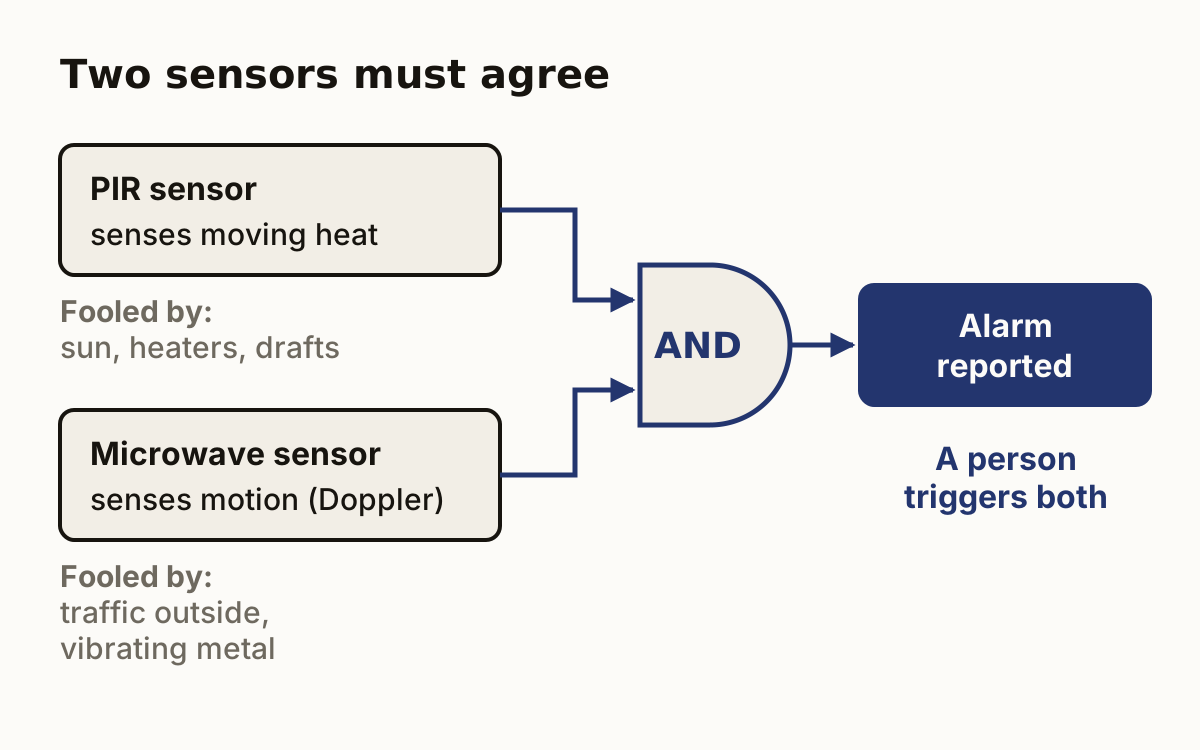
A detector that combines a passive infrared (PIR) sensor and a microwave sensor, and reports an alarm only when both trigger within a short window of each other.
Why does a PIR motion detector give false alarms?
Because it senses moving heat, not people, so sunlight, heaters, warm drafts and moving objects can all look like an intruder.
Start with the ordinary detector, the passive infrared one, because it is what nearly everything is. A passive infrared sensor — PIR — does not see a person. It sees the infrared energy in a room, divided by a lens into a fan of separate zones, and it watches for that energy pattern changing as something warm crosses from one zone into the next. We cover the mechanism in more detail in how PIR detectors actually work.
The important consequence is this: the sensor has no concept of an intruder. It has a concept of a thermal contrast that moved. A person walking through the room produces one. So do a number of other things:
- Sunlight tracking across a floor or a wall through the day, and the sharp edge of a shadow moving with it.
- A unit heater or an air handler cycling on and pushing a body of warm air across the space.
- A radiant heat source warming a surface — a metal roller door, a wall, a stack of pallets — which then re-radiates unevenly.
- Objects that move in moving air: hanging signage, banners, seasonal decorations, plastic strip curtains, sheeting over stock.
- Small animals at close range, and birds inside high spaces.
Every one of those is a real, physical, correctly detected thermal event. The detector reported honestly. The report was simply not the thing you cared about.
You cannot fix this by turning the sensitivity down, though everyone tries. Turning it down does reduce the false alarms — and it reduces detection of people in exactly the same proportion, because the sensor has no way of telling the two apart. Sensitivity is a volume knob, not a filter. What you actually want is a second opinion.
The other half of a dual-technology detector is an active microwave sensor, and the word that matters is active. Where the infrared side sits passively and receives, the microwave side transmits a low-power radio signal into the room and listens to what comes back.
Moving objects change the returned signal in a way that stationary ones do not — the classic Doppler shift, the same effect that makes a passing siren drop in pitch. The detector is looking for that shift.
Notice what this sensor does not care about. It does not care about heat. Sunlight does not move it. A heater cycling on does not move it. A warm wall re-radiating in the afternoon does not move it. The entire list above — the list that torments a PIR — is very nearly invisible to it.
It has its own list instead, and the list is completely different:
- Radio energy passes through some building materials. A microwave sensor can therefore detect movement it should have no business seeing: traffic or pedestrians past a window, activity in the neighbouring tenancy through a stud partition, a vehicle in the lane behind a light exterior wall.
- Vibration on metal. Ductwork, fans, compressors, roller shutter slats and pipework can all move enough to register.
- Water in motion — a running downpipe, drainage after heavy rain.
- Reflective surfaces and enclosed metallic spaces, which send energy where the installer did not expect it to go.
- Fluorescent and some other lighting, which can inject noise into the sensing band as it strikes and flickers.
Read the two lists side by side. That is the whole argument for dual-technology detection, and it is a statistical argument dressed up as a hardware one.
PIR vs microwave
How does a dual-tech detector reduce false alarms?
The two sensors are fooled by different things, so requiring both to agree filters out ordinary nuisance, while a real intruder, warm and moving, triggers both.
The two sensors fail for unrelated reasons. Sun on a wall does not create a Doppler shift. A truck in the lane outside does not create a thermal contrast crossing the lens zones inside your room. The events that fool one are, in the overwhelming majority of cases, invisible to the other.
A genuine intruder is the opposite case. A person walking into a protected space is warm, and moving, and inside the room. They present both signatures at once. That is the only class of event that reliably does.
So the detector is wired with an AND gate. Both sensing channels must be in an active state within a short window of one another before the unit reports an alarm at all. One channel alone reports nothing to your panel.
The effect on false alarms is not incremental. Because the two triggering populations are largely independent, requiring agreement does not subtract one list from the other — it requires the improbable coincidence of an event from both lists landing inside the same short window. Most of the ordinary nuisance simply stops arriving.
The honest trade
Here is the part that is usually left out of the sales conversation, and it is the reason to write the specification carefully rather than just ticking a box.
An AND gate can only ever remove alarms. It cannot add one. Any event that a single PIR would have reported, a dual-tech unit may decline to report — including a real one. If an intruder is present but only one channel sees them, nothing is sent. Requiring two sensors to agree buys quiet at the cost of a marginally higher chance of missing a genuine event.
That is the trade, stated plainly. Two things stop it from being a bad one.
The first is that the two technologies have complementary blind spots as well as complementary false triggers. A PIR is at its weakest when something moves slowly and directly toward it, because that motion crosses very few lens boundaries. Doppler sensing is at its strongest in exactly that geometry, because motion along the line to the sensor produces the largest shift. Motion across the room is the reverse — excellent for the PIR, weaker for the microwave. The pairing is not two sensors with the same weakness; each is strongest where the other is softest, which is why an AND gate over these two particular technologies stays far more sensitive in practice than the logic alone would suggest.
The second is that the trade only makes sense where the nuisance is real. Which brings us to where these things belong.
Where should you use dual-tech detectors?
Where nuisance alarms are real: high ceilings, heated or drafty spaces, large glazing, loading docks, and any zone with a history of unexplained alarms.
High-ceiling spaces. Warehouses, distribution facilities, arenas, atriums. Long detection ranges, thermal layering under the roof, and birds. A single PIR asked to cover a large volume has to be run at a sensitivity that all but guarantees nuisance.
Anywhere with significant heating or air movement. Unit heaters, rooftop units, radiant tube heaters, big fans, air curtains, doors that open onto outside air. Moving air is one of the most common causes of the alarm that nobody can explain the next morning.
Spaces with large glazing or direct sun. Showrooms, retail frontages, lobbies. The sun moves every day and shifts its arc every month, so a detector commissioned in November may start misbehaving in April with nothing having changed indoors.
Loading docks and vehicle areas. Warm engines, exhaust, roller doors that move and re-radiate heat, and outside air arriving all at once.
Any zone with a history. This is the strongest signal available to you, and it costs nothing to look for. Pull your event log and find the zones that generate alarms nobody could account for. Those zones have already told you what they need.
Equally, know where it is unnecessary. Small interior rooms, corridors, stockrooms with stable temperatures and nothing hanging from the ceiling — a well-sited single PIR is fine, and the money is better spent elsewhere. Dual-technology units cost more per point, draw more current, and take longer to commission properly. Fitting them everywhere as a reflex is a way of paying for the fix in the places that never had the problem.
Siting is not an afterthought — it is most of the result
A dual-tech detector installed carelessly can be worse than the PIR it replaced, because the microwave channel introduces a failure mode that did not previously exist: seeing outside the room.
The things that matter, and the things to ask your installer to confirm in writing:
The microwave range is adjusted, not left at the factory setting. Nearly every unit has a range control. It should be set so the sensing field ends inside the protected space rather than reaching through a partition, a window, or a light exterior wall into somewhere with traffic. This is one of the most common commissioning failures on these devices.
Nothing that moves is inside the field. Fans, hanging stock, ductwork under load, plastic strip curtains. Both channels are affected, for different reasons.
Mounting is solid, level, and at the height the manufacturer specifies. Detection patterns are designed for a mounting height. Fitted higher or lower, the coverage on the floor is not what the drawing shows. A detector on a flexing panel or a stud wall shared with machinery has vibration coupled straight into it.
The unit is out of the direct sun path, and away from heat sources. Not just where the sun falls today — where it will fall in the other three seasons.
Both channels are walk-tested independently, then together. If only the combined result is tested, a dead channel can hide behind a working one for years.
The result is written down per device. Mounting height, range setting, coverage, test date. A detector nobody can describe is a detector nobody can troubleshoot.
Why this is a business decision, not a technical one
Two costs sit behind all of this.
The first is direct and municipal. False alarm charging in BC is set by each municipality under its own bylaw, and the models differ structurally between neighbouring cities — some charge from the first occurrence, some allow a small number free and then escalate with each subsequent one within a calendar year, as Burnaby's fee schedule does. A recurring nuisance zone is therefore not a fixed annoyance; in an escalating model it becomes progressively more expensive as the year goes on. We have set out how those bylaws actually work, and why the fee table on a city web page is usually not the instrument that governs, in false alarms and what they actually cost you in BC.
The second cost is larger and never appears on an invoice. A system that cries wolf gets managed around. Zones get bypassed. Openers stop arming areas they know will misfire. Keyholders stop attending. Monitoring gets a reputation internally as noise, and the one night the alarm is real, it is treated exactly like the fifty nights it was not.
That is what you are actually buying when you specify a dual-technology detector for a difficult space: not more sensitivity, but a system whose alarms people still believe in.