There is a category of site where the usual answers do not fit. A long fence line at the back of a yard. A rail spur. A boundary between a laydown area and a public trail — a property edge measured in hundreds of metres rather than tens, with no power along it and nothing to mount a camera on.
For that shape of problem, the photoelectric beam detector is one of the few honest answers. It is also the device most often sold on a summer demonstration and bought without anyone asking what it does in February.
How does a photoelectric beam detector work?
A transmitter sends an infrared beam to a receiver, and the receiver signals an alarm when the beam stops arriving.
A beam detector is a pair: a transmitter at one end of a line and a receiver at the other. The transmitter emits an infrared beam, the receiver watches for it, and when the beam stops arriving the receiver signals an alarm.
That is the entire mechanism, and its simplicity is why it works over distances where nothing else does. No image to process, no scene to interpret, no analytics model to be right or wrong about a shape — only a line, and the question of whether it is intact.
Some units need power at both ends. Others fold the path back with a reflector so the electronics sit in one housing, which halves the effective reach but also halves the number of places you must run cable to. On a fence line with power at one corner, that difference decides the design.
Why serious units stack multiple beams
A single beam has an obvious problem: everything that crosses it produces the same signal. A person, a raccoon, a gull settling on the fence rail, a tarp lifting off a pallet — all break one line identically.
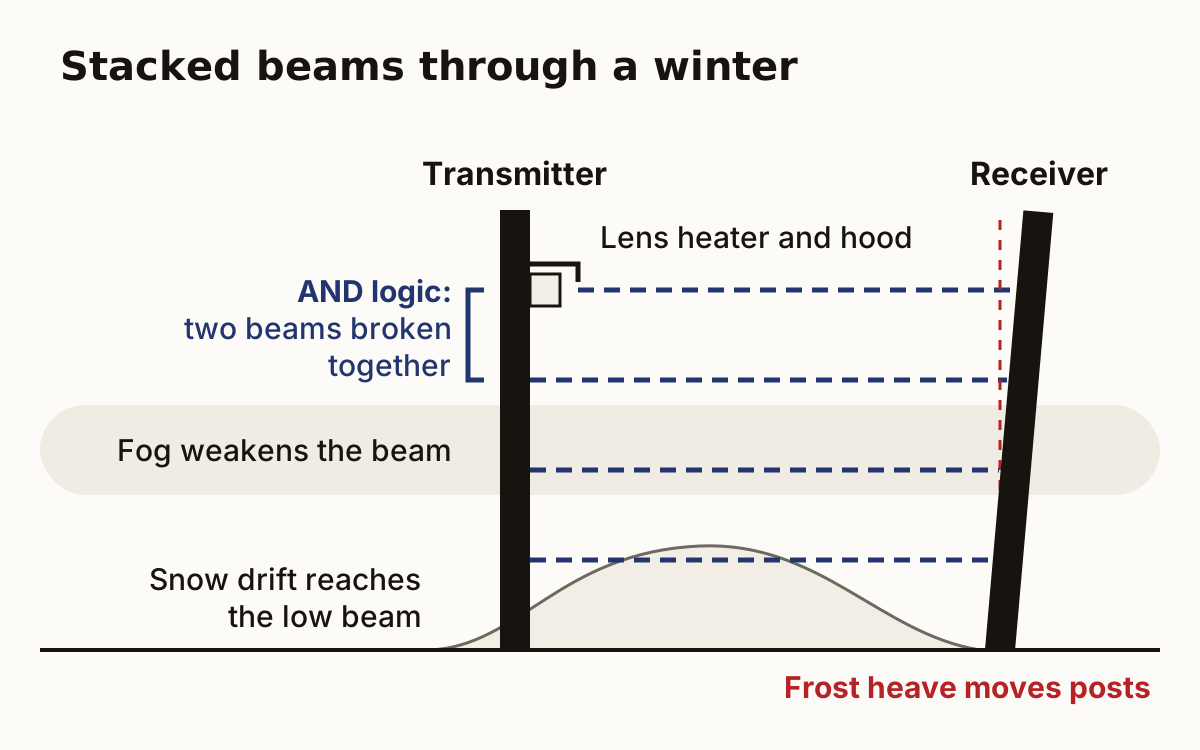
The standard answer is to stack beams vertically in one column and require more than one to be interrupted at the same time — usually described as AND logic: the unit alarms only when beam one and beam two are broken together. The gull, occupying one narrow horizontal band, no longer alarms. Neither does the tarp corner, most of the time. A person occupies a substantial vertical slice of the column and breaks both.
Better units let you configure this — how many beams, which pairs, and how long the interruption must persist before it counts. That timing setting does more work than people expect: a bird is a very short break and a person crossing a longer one, so a minimum duration discards a large class of nuisance events without discarding anything that matters.
If you are being quoted a beam system, ask how many beams are in the column, whether the logic is configurable, and whether the timing can be tuned on site after a season of watching it live. A single-beam unit with no adjustment is not a cheaper version of the same thing. It is a different, worse thing.
A beam is a line, not an area
This is the limit to be honest about before anything else.
A beam tells you something crossed a line. It does not tell you what crossed, or where along the line it happened — on a long run the alarm is identical whether the interruption was at the near post or the far one. An alarm meaning "something, somewhere along that line, at ten past three" is only actionable if something else can answer the other two questions. Otherwise you have bought a device that reliably wakes someone to look at a dark field.
So a beam belongs paired:
- Beam plus camera. The beam is the trigger worth believing; a camera covering that zone supplies the image. On a long perimeter, split the line into several beam zones so the alarm at least tells you which stretch to look at, and cover each zone.
- Beam plus thermal. Thermal has the opposite profile: it covers an area rather than a line and is largely indifferent to darkness, glare and rain, but it costs considerably more per metre of perimeter and will never identify anyone. On a large site the usual answer is beams across the long, uncontested runs and thermal at the two or three places someone would actually choose to enter.
The question is not "beams or thermal". It is which parts of your perimeter are worth which instrument.
Where beams genuinely suit
Long straight runs with clear line of sight. The advantage is distance at low cost per metre. Straight is a requirement, not a preference — a beam does not go round corners, so every corner means another pair of devices, another alignment, another thing to maintain.
Boundaries with no power and no mounting structure. Where the alternative is trenching for camera power along a fence, a pair at the two ends is a far cheaper build.
Approaches you want supervised rather than watched. Some parts of a site do not need to be seen; someone just needs to know if they were crossed. A rear gate that should never open outside working hours, a fuel compound. Those are supervision problems, and a beam is a supervision device.
In each case, insist the unit's own trouble states — misalignment, low signal, tamper, prolonged obstruction — are reported like any other protected circuit. The reasoning behind end-of-line resistors on a supervised loop applies: a detector that fails silent is worse than no detector, because you have stopped watching that line and nobody told you.
What are the disadvantages of photoelectric beam detectors?
A beam only tells you a line was crossed, not what or where, and outdoors in winter fog, snow, lens ice and ground movement can weaken or break it.
What range should you design a beam for?
Well inside the rated range, not near the maximum: the margin between the two is what absorbs fog, rain and snow.
Manufacturers publish a rated detection range and, beyond it, a much longer maximum arrival distance. Optex calls that figure the optical margin for the detection range, Takex lists it as a tenfold margin distance, and SECO-LARM publishes an outdoor range about half its indoor range. The margin matters because rain, snow and heavy fog weaken the beam — enough, in Optex's and Takex's own manuals, to trigger a trouble signal. In BC, reduced visibility is not an edge case. It is a season.
Fog, driving rain and heavy snow attenuate the beam. Water droplets and snowflakes scatter infrared. The receiver still sees the beam but sees less of it, and every unit has a threshold below which "weak" becomes "absent" and it alarms. This is one of the most common causes of winter nuisance alarms, and the failure mode is unhelpfully seasonal: the system behaves impeccably from April to October, then produces a run of small-hours alarms in the first serious fog, by which point everyone has forgotten how it was commissioned. Fraser Valley river fog and the coastal marine layer are both exactly this problem.
The mitigation is margin. A beam installed well inside its rated range has signal to spare and can lose a great deal to weather before dropping below threshold. One installed at the edge of its rating has none. The most consequential winter decision on a beam system is made in summer, when someone chooses how far apart to put the posts. If that distance was set by where the existing posts happened to be, rather than by a deliberate derating for weather, the winter behaviour is already decided.
Snow accumulates under the beam until the drift itself breaks it. The beam sits at a fixed height above grade. Snow does not. On a site that gets real accumulation — and more of BC does than the coastal stereotype suggests — the snow surface rises toward the lower beams, and a plough windrow or a drift against a fence rises far faster than open ground. Eventually the lowest beam is looking through, then into, a snowbank. AND logic saves you for a while, since one buried beam does not alarm alone, and stops saving you when the second goes.
Snow clearing is the second-order version of the same problem. The pile has to go somewhere, and a contractor with a plough has no idea the invisible line matters. Posts get buried, clipped and knocked out of true by snow removal more often than by anything a trespasser does. Put the beam line in the site's snow-clearing instructions, and mark the posts above snow line.
Ice, frost and condensation on the lens. The optical face is the whole device. Freezing rain glazes it, blowing snow packs against it, a cold lens on a humid morning fogs like a car windscreen. Any of these blocks the beam from a few centimetres away, which no installed margin protects against. This is why serious outdoor units offer lens heaters, and why on a BC site — especially east of the coastal strip, or at elevation — a heater belongs in the specification rather than the upsell column. It also argues for hoods and orientation: a lens facing into the prevailing weather collects the prevailing weather.
Frost heave and freeze-thaw move the posts. Alignment is angular, and over the distances beams are used for, a very small rotation at one end moves the received spot a long way at the other. Ground that freezes, expands, thaws and settles does exactly that to a post — and BC's repeated crossings of zero are harder on a shallow footing than one long deep freeze. So a pair aligned perfectly in September can be marginal in January and out of tolerance by March with nobody touching it. Posts on footings below frost depth move less; posts bolted to an existing fence move as much as the fence does, and a fence line is not a survey monument.
Short days mean more hours in the difficult conditions. In the depths of a BC winter the sun is up for a small fraction of the day, and every dark hour is one the perimeter is doing the job you bought it for. Those hours overlap almost exactly with the cold, damp, fog-forming part of the cycle: the system's hardest conditions and its highest-value hours are the same. A July demonstration inverts that, which is why it tells you little.
Winter problems and fixes
The maintenance reality
Alignment is not a one-time task. Vendors present it as a commissioning step. In this climate it is recurring maintenance, because the ground moves, the posts move, the fence moves, and the snow contractor moves things too. A system with no scheduled realignment suffers a slow, invisible decline in margin, and you find out through a run of nuisance alarms — or worse, through a crossing that raised no alarm because the signal had already collapsed and nobody was monitoring the trouble state.
A workable BC rhythm:
- Autumn, before the weather turns. Clean every lens, correct alignment, and record the received signal level the unit reports — that number is the whole health picture and is meaningless without an earlier reading to compare it to. Confirm heaters work before you need them. Cut vegetation back with a season's growth in mind.
- Mid-winter, after the first serious weather. Snow height under the beam line. Ice on the optics, hoods that have filled rather than shed. Whether the posts are still where they were.
- Spring, once the ground has settled. Realign. This is the one people skip and the one that matters most, because freeze-thaw has just finished its work.
- After any snow-clearing season or fence work. Anyone who has been near the posts has plausibly changed the geometry.
Keep the readings in a log. One tells you the beam works today. A series tells you the margin is eroding — the only warning you get before the winter alarms start.
There is a cost to ignoring that. A beam that nuisance-alarms through fog season does not stay armed — it gets bypassed "for the winter", and the bypass outlives the winter, leaving an unprotected perimeter everyone believes is protected. Repeated alarms that bring someone to a site are also billable events in several Lower Mainland municipalities. Read what false alarms actually cost you here before you commission, not after the first invoice.
The short version
A photoelectric beam is a good, cheap, honest answer to a long boundary. It is a line; it tells you the line was crossed and nothing else, so pair it with something that can say more.
Specify it well inside its rated range so weather has something to eat into. Assume lens heating. Put the posts on footings that will not move, and expect them to move anyway. Tell your snow contractor where the line is. And book the realignment twice a year — because what people underestimate about beam detection in this climate is not the equipment. It is that alignment is a maintenance programme wearing the costume of an installation step.