Nearly every sensor in a commercial intrusion system is watching a space. A motion detector watches a room. A beam watches a line across a corridor. A magnetic contact watches an opening — the gap between a door and its frame. Different technologies, different failure modes, same underlying subject: a volume of air, or a boundary around one, with the sensor waiting for something to move through it.
Seismic detection is the exception, and that one difference is most of what an owner needs to know about it.
A seismic detector — often called a vibration or structural detector — is fixed to the thing being protected. Not to the wall opposite it, not to the ceiling above it. To it: a safe body, a vault wall, an ATM surround, the concrete of a strongroom. What it monitors is not the space around that structure but the structure itself — the mechanical energy travelling through the material it is attached to.
That changes what it can tell you, and when.
How does a seismic sensor work?
It is fixed to the structure it protects and senses mechanical energy travelling through that material, so an attack on the structure registers while it is still intact.
Consider the sequence of events an ordinary system observes when someone gets at a safe overnight.
The perimeter contacts report a door or window. A motion detector reports movement in the room. And then — nothing. Someone standing next to the safe, working on it, is simply a person in a room that has already alarmed. If those first signals were missed, defeated, or dismissed as another false alarm, the system has nothing further to say. The next event it can report is often the moment the container is open, if it can report that at all.
A seismic detector inserts a signal into that gap. Because it monitors the structure, it responds to an attack on the structure, while the structure is still intact. It is not waiting for a door to swing or a person to cross a beam. It is listening to the material.
That is the entire argument for the technology, and it reduces to one word: time.
Time is the only currency that matters once someone is working on a vault. Every measure around a high-value container — the construction of the container, the delay it imposes, the response arrangement, the guard tour schedule, the monitoring contract — exists to buy minutes and then spend them usefully. A detector that alarms at the beginning of an attack rather than at the end of one is not a marginal improvement in sensor coverage. It changes what a response can arrive in time to affect.
We are not going to describe how anyone attacks a safe, what tools are involved, or how any container is breached — and you should be wary of any vendor whose sales material is more forthcoming. The point for an owner can be stated without any of that: an attack on the structure puts energy into the structure, and there is a class of sensor built to notice.
How do seismic detectors avoid false alarms?
By processing: a good detector judges the signature of a vibration, not just its presence, and is commissioned against the building's normal background.
Here is where most of the engineering actually lives, and where most disappointing installations go wrong.
A building is not a quiet place, mechanically. Consider what is already putting vibration into the structure your safe sits on:
- Truck traffic on the street, and the loading bay behind the building
- HVAC plant cycling on a schedule, plus rooftop units, pumps and compressors
- Elevators, escalators and door closers
- Deliveries — pallet jacks, dropped cartons, dollies over thresholds
- Cleaning crews, floor scrubbers, the vacuum banged into the cash room wall nightly
- Adjacent tenants, construction next door, roadworks that may run for months
A detector that reacts to vibration is going to encounter every one of those. So the useful question is never "will it detect vibration" — of course it will — but how it distinguishes an attack from the ordinary mechanical life of the building around it.
That distinction is a processing problem. A good seismic detector is not a switch that closes above a threshold; it characterizes what it receives, looking at the signature of the energy rather than merely its presence. Attacks on a structure and ordinary building activity do not look the same in that signature, and the value of the device lies in that analysis, not in its sensitivity. Any crude detector can be made extremely sensitive. Sensitivity without discrimination is a false alarm generator fixed to your most sensitive asset.
This is the same argument that governs dual-technology detectors in ordinary space detection: the interesting engineering is not in noticing an event, it is in refusing to report the wrong ones. On a vault, the stakes run both ways. A detector that cries wolf gets adjusted down, then ignored, then bypassed by whoever is tired of the calls — and a bypassed detector is worse than none, because it occupies the line item that would otherwise have prompted a real solution. A detector set too conservatively to survive the building's noise floor may not be doing the job it was bought for at all.
There is no way to resolve that tension from a catalogue. It is resolved on site, by commissioning: a competent installer tests against the actual environment, adjusts, re-tests, and records what was done.
On BC sites we install DSC's SS-102 wired shock sensor and its PowerG PG9935 wireless shock detector. DSC describes the SS-102 as able to detect and analyze seismic vibrations caused by attempted break-ins, and publishes typical detection radii for it — 3 m on steel, 1.5 m on concrete, 2.5 m on brick — with the warning that the values must be tested at each installation. Its instructions set sensitivity by tapping the protected area and turning the sensitivity down until the unit only just responds.
Where should a seismic detector be mounted on a safe?
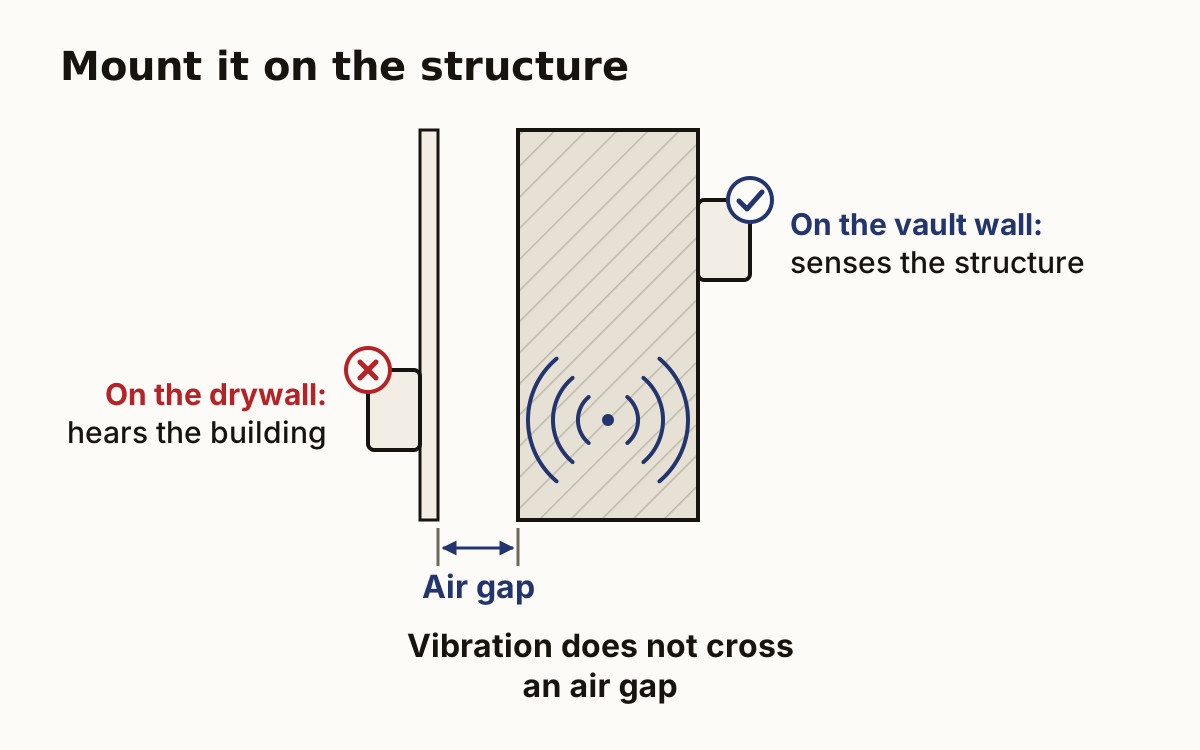
On the protected structure itself, never on the wall beside it or the ceiling above it, because vibration does not cross an air gap.
The siting rule for seismic detection is unusually blunt, and it is the one most often broken by a well-meaning installation.
The detector must be mounted on the structure being protected. Not on the wall beside the safe. Not on the ceiling above the vault. Not on the frame of the room the vault stands in. Vibration does not cross an air gap from one body into another, and it is attenuated and distorted by every joint, mount and material change along the path it does take. A detector attached to the drywall next to a vault is monitoring the drywall: it hears the building loudly and the vault faintly, which is exactly the wrong ratio.
Two consequences follow. Mounting is a physical intervention on a valuable and often certified object, so it must be planned rather than improvised — including where on the structure the device sits, because a large structure does not transmit uniformly. And for many sites the sensor should be fitted in coordination with the people responsible for the container itself. An integrator proposing to drill something you own without that conversation is proposing to make your problem worse.
It is a layer, not a replacement
Seismic detection replaces nothing. It is added to a design that already works, to cover a case the rest of the design cannot see.
The rest of that design is doing real work. Contacts on the vault or safe door report the obvious condition — the door has moved — unambiguously and cheaply. (What contacts can and cannot tell you, including how their supervision interacts with building systems, is covered in magnetic contacts and building management systems.) Space detection in the anteroom reports presence. Video gives you the record and the assessment. Access control decides who should be in the room at all.
Each is blind to a specific thing. Contacts cannot report anything until something opens. Space detection cannot tell an attack on the container from a person standing beside it. Seismic detection covers the interval between "someone is in the room" and "the container is open", which is the interval in which everything is decided.
What each sensor on a vault can tell you
There is a monitoring consequence worth settling in advance. A seismic alarm from a vault is not an ordinary intrusion signal and should not be handled like one. Agree with your monitoring provider, in writing, what happens when that zone activates, who is notified and in what order. A high-value early-warning signal that lands in the same queue as a windy-night door contact has been wasted.
The maintenance point nobody mentions at the quote stage
Here is the item that reliably surprises owners, and it follows directly from everything above.
A seismic installation is calibrated against a building's normal vibration environment, and that environment is not a constant. Replace the rooftop HVAC plant and you have changed it. Add a compressor, a new elevator, a car stacker, or a gym on the floor above and you have changed it. A neighbouring lot going into excavation changes it, sometimes dramatically, for a year. Even a new tenant's delivery pattern shifts the mechanical background the detector is judging against.
When that background changes, the calibration that was correct at commissioning is not. It drifts one of two ways: a system producing activations nobody can explain, or — quieter and worse — a system desensitized to cope with a new noise source, now less capable than its owner believes.
So treat recalibration as both a scheduled item, part of the annual service, and a triggered one, whenever the building's mechanical environment changes materially. Make sure whoever manages your building projects knows to mention it, because facilities and security rarely talk to each other about plant replacement.
What are seismic vibration sensors used for?
Protecting concentrated, high-value containers such as safes, vaults, strongroom walls and ATM surrounds at financial premises, cash-handling sites, jewellers and secure storage.
This is specialist equipment for a narrow set of assets. Most buildings do not need it and should not buy it.
It belongs where there is a specific, concentrated, high-value container whose loss would be serious, and where that container is deliberately hard to get into — because the premise is that the structure imposes delay, and the detector's job is to make that delay useful by starting the clock at the beginning of it. Financial premises, cash-handling operations, jewellers, precious-metal and pharmaceutical storage, secure records, firearms storage, ATM estates. If your safe is a small unit holding petty cash and a spare set of keys, seismic detection is not the next thing to spend money on; contacts, decent space detection, sound commissioning and a keyholder list that is actually current will do more for you.
It is also not a general upgrade, and nobody should be adding it to a standard commercial intrusion package to make a quote look thorough. If it appears in a proposal for a site with no concentrated high-value container, ask what specific asset it protects and what failure it prevents. A good answer names the asset. A vague answer means it is filler.
What to ask, if it does apply to you
- What exactly is it mounted on, and where on that structure? The answer should name the protected body itself and show coverage of it, not a single convenient spot.
- How was it commissioned against this building's noise floor? What was tested, what was adjusted, was it re-tested — and is that recorded.
- What did the site look like mechanically at commissioning? This is the baseline you will want when something changes in two years.
- What happens on activation? Names, order, expected response, in writing, and different from ordinary intrusion handling.
- What triggers a recalibration visit, and what does it cost? Settle this before you sign, not after the excavator arrives next door.
- Does fitting it affect the container's certification or warranty? Get that confirmation from the party responsible for the container, not only from the integrator.
An installer who does this work regularly will answer all six without hesitation. One who goes vague around commissioning and recalibration is telling you they sell the box and not the outcome.
The short version
Space detection asks whether anyone is in the room. Seismic detection asks whether anything is happening to the structure — and because it is attached to that structure, it can answer while the container is still intact, which is the only moment at which the answer is worth much.
The technology stands or falls on two unglamorous things: whether its processing can tell an attack from a delivery truck, and whether it is mounted on the right object and calibrated against the real building. It is a narrow tool for a narrow problem. Where the problem exists, nothing else in the system covers it. Where it does not, this is money that belongs elsewhere in your design.